
BMW 3: Innovations B46TU/B48TU
BMW 3 Series G20 (2018-2026) Training manual / B46TU-B48TU Engines / Introduction / Innovations B46TU/B48TU
Innovations B46TU
To meet the legal requirements for emissions, a number of technical improvements have been implemented. The technical updates for the B46TU engine include the following new features:
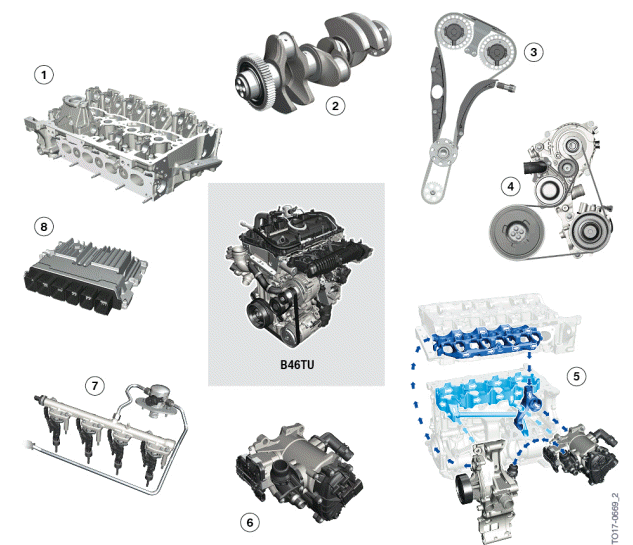
New features
- Modified cylinder head
- Crankshaft weight reductions
- Single-part timing chain drive
- Modified belt guide
- Split cooling
- Heat management module with electrical Split Cooling Valve (SCV)
- Fuel preparation with 350 bar (5076 psi) injection pressure
- DME 8
Weight savings in the crankshaft drive area, injection pressure boosting in the fuel preparation area, and function changes in the engine cooling area have made it possible to reduce the CO2 emissions by 2.5 - 5%, while increasing engine performance by 5 kW/20 Nm (8 hp/15 lb-ft).
Innovations B48TU
The technical improvements made to the B48TU engine a highlighted below:
- 302 hp (225 kW)
- 332 lb-ft (450 Nm)
- Reinforced crankshaft with larger main bearing diameter.
- New piston with modified compression.
- New connecting rods without a bearing on small end.
- Newly developed larger exhaust turbocharger with integrated air-diverter valve.
- Modified fuel injectors with increased flow rate and 350 bar pressure.
- Newly developed intake air pipes for higher power and torque.
- Modified exhaust system to minimize back pressure.
- Engine cover with M Performance logo.
READ NEXT:
 Engine identification
B46TU engine
Engine identification - transverse mounted shown
B48TU engine
Engine identification - transverse mounted shown
Engine number
Engine identification
The 7-digit engine identification
Engine housing, Crankshaft drive
Engine housing
Cylinder head
The cylinder head is made of aluminum.
Only slight modifications have been made to the B46TU head compared to the B46.
Cylinder head
Crankshaft drive
Crankshaft
Comparis
SEE MORE:
Speed Limit Info
Speed Limit Info
Concept
Speed Limit Info shows the currently valid speed
limit in the instrument cluster and, if necessary,
the Head-up Display.
General information
The camera in the area of the interior mirror detects
traffic signs at the edge of the road as well
as variable overhead sign posts.
HYBRID
In the HYBRID driving mode, the vehicle chooses the optimum drive combination
depending on
the state of charge of the high-voltage battery unit and accelerator pedal
position. If the driver's
power request exceeds the maximum available electrical power, the combustion
engine is activated
automati
© 2019-2026 Copyright www.bmw3g20.com
