
BMW 3: Connections
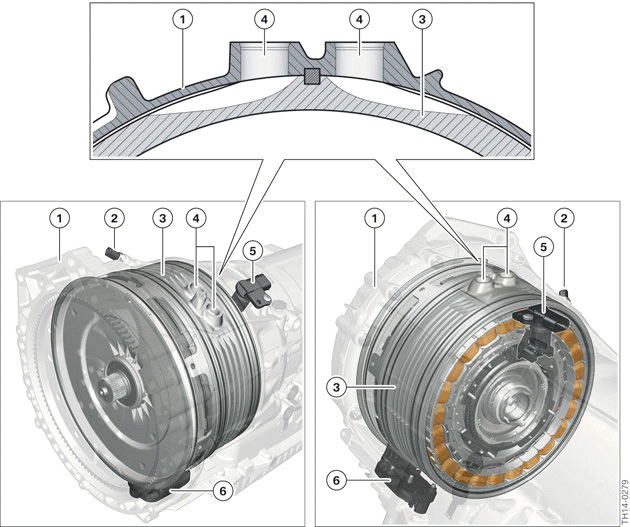
Connections, electrical machine
- Transmission bell housing
- Temperature sensor
- Coolant ducts
- Connection for coolant (transmission oil)
- Electrical connection, rotor position sensor
- High-voltage connection
There are four connections of the electrical machine on the housing of the automatic transmission for the following components:
- Temperature sensor
- Cooling (by transmission oil)
- Rotor position sensor
- High-voltage cables
High-voltage connection
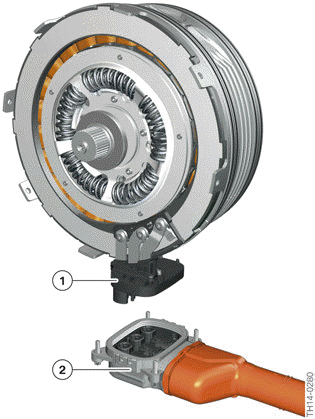
High-voltage connection, electrical machine
- High-voltage connection
- High-voltage connector
Electrical energy is fed to the coils of the electrical machine via the high-voltage connection. The high- voltage connection connects the Electrical Machine Electronics to the electrical machine via a three- phase, shielded high-voltage cable.
The high-voltage connectors are screwed on to the Electrical Machine Electronics and the electrical machine.

High-voltage cables must not be repaired. In the event of damage, the line must always be replaced!
READ NEXT:
 Sensors
Sensors, electrical machine
Temperature sensor
Rotor of the rotor position sensor
Stator of the rotor position sensor
So that the voltages for the coils in the stator can be correctly calculated
Separation clutch
The G20 PHEV is a Full-Hybrid Generation 4.0 vehicle. In contrast to
generation 2 and 3 hybrid
vehicles, electrical driving is possible in the G20 PHEV at much higher speeds
and with a higher range.
Cooling
To guarantee the thermal operating safety of the electrical machine in every
situation, it is cooled with
coolant in the G20 PHEV. For this, the electrical machine is integrated in the
coolant
SEE MORE:
Jacking points for the vehicle
jack
The jacking points for the vehicle jack are located
at the indicated positions.
Jacking up the vehicle
Warning
Hands and fingers can be jammed when using
the vehicle jack. There is a risk of injury. Comply
with the described hand position and do not
change this position while using the vehicle
jac
Stored stations
General information
Up to 50 stations can be stored.
Selecting a station
1. "MEDIA".
2. "Radio".
3. "Presets".
4. Select the desired station.
Deleting a station
1. "MEDIA".
2. "Radio".
3. "Presets".
4. Highlight the station you want to delete.
5. Move the Controller to the right.
6. "Delete
© 2019-2026 Copyright www.bmw3g20.com
