
BMW 3: Belt drive
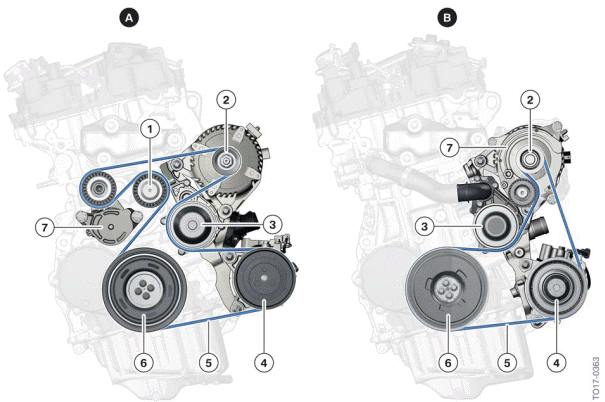
Comparison belt drive B46 engine and B46TU/B48TU engines
- B46 Engine (transverse installation shown)
- B46TU/B48TU engines (transverse installation shown)
- Deflecting element
- Alternator
- Coolant pump
- Air conditioning compressor
- Ribbed belt
- Torsional vibration damper
- Belt tensioner
The belt layout is a single-belt drive where all ancillary components are driven by one belt.
Changing the belt guiding has help to save both material and space.
The length of the drive belt changes due to thermal expansion and ageing. So the drive belt can transmit the required torque, it must be continuously in contact with the belt pulley at a defined pressure. To allow this to happen, the belt tension is exerted by an automatic tensioning pulley mounted on the alternator; the pulley compensates for belt elongation over the full service life.

In case of incorrect assembly of the drive belt, the coolant flow through the coolant pump is either insufficient or non-existent; there is thus a lack of cooling. There is a risk of damage to engine components and engine damage
READ NEXT:
 Split cooling
Split cooling is a new development for the B46TU engine. This cooling concept
is a modified version
of which is already used in the N63TU2.
The Split Cooling function uses the electrical Split Cooli
Heat management module
The heat management module replaces the characteristic map thermostat.
Heat management module
Electrical Split Cooling Valve (SCV)
Coolant output towards the coolant pump
Electrical actuator
Rot
SEE MORE:
Switching on/off and interrupting
cruise control
With steering and traffic jam
assistant: Assisted Driving
General information
This button is used to switch the
configured
function on and off.
The button can be used to set the
primarily
used function.
Set function
1. When the system is active,
press the
button repeatedly until the desired funct
Maintenance
BMW maintenance system
The maintenance system indicates required
maintenance measures, and thereby provides
support in maintaining road safety and the operational
reliability of the vehicle.
In some cases, scopes and intervals of the maintenance
system may vary according to the country
version. Rep
