
BMW 3: Introduction
Although the high-voltage battery unit of the G20 PHEV can also be partially charged by energy recovery via the electrical machine, the "normal" charging procedure takes place when the G20 PHEV is connected to the AC voltage network of the local power supply company. Energy is taken from the alternating current voltage network and fed to the direct current voltage high-voltage electrical system.
To allow this to happen, the G20 PHEV can be connected to an AC charge station or charged via the charging cable.
The charging procedure is never carried out with the maximum possible charge current. At the start, charging takes place with constant current. Switchover to constant voltage takes place towards the end. The actual charging time is increased as a result, and the service life of the battery cells is extended.
If the G20 PHEV is connected to an AC charging station, the maximum possible charging power of approximately 3.7 kW is also available (provided the AC charging station is designed for this).
System wiring diagram
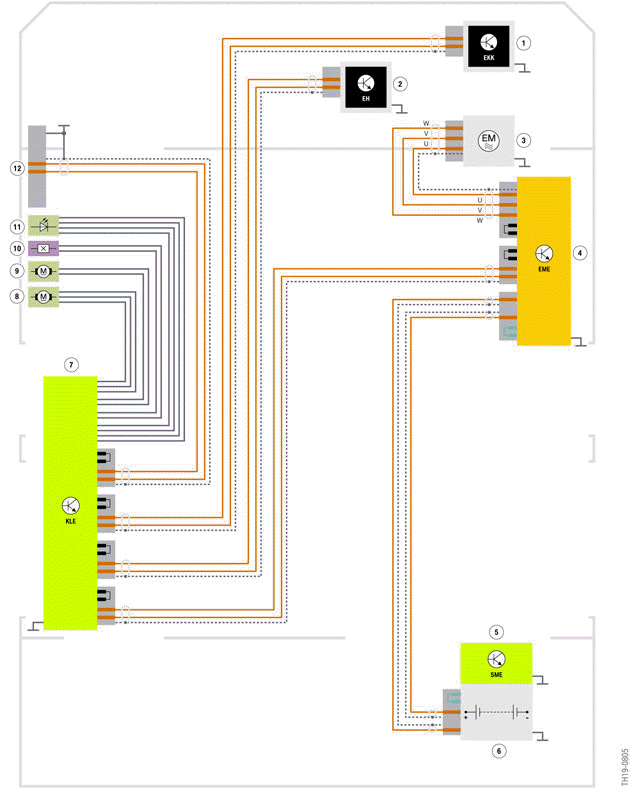
System wiring diagram for AC charging with 3.7 kW
- Electric A/C compressor (EKK)
- Electrical Heating (EH)
- Electric motor
- Electric Motor Electronics (EME)
- Battery management electronics (SME)
- High-voltage battery unit
- Convenience charging electronics (KLE)
- Drive, connector fastener
- Drive, charging socket cover
- Charging socket cover sensor
- Locator and status lighting
- Charging socket at the vehicle
READ NEXT:
 Introduction
The "charging" procedure for an electric vehicle corresponds to "refuelling"
a conventionally driven
vehicle. Accordingly, in this chapter "charging" means:
Charging the high-voltage battery unit d
Overview of charging options
The high-voltage battery unit of the G20 PHEV can generally only be charged
by alternating current
(AC charging) at a maximum charging power of 3.7 kW. The charging option for the
high-vol
SEE MORE:
Warning function
Light in the exterior mirror
Prewarning
The dimmed light in the exterior mirror indicates
when there are vehicles in the blind spot or approaching
from behind.
Acute warning
If the turn signal is switched on while a vehicle is
in the critical zone, the steering wheel vibrates
briefly and the light
Equipotential bonding
The low-resistance connection between the housing of the high-voltage battery
unit and ground is
a crucial prerequisite for the fault-free function of the integrated isolation
monitoring. This is why it
is important to observe the correct tightening torque for all assembly screws.
It is also impo
